10 Most Valuable Mercury Dimes: Value Guide for Collectors
The most valuable Mercury dimes are the following:
- 1916-D Mercury Dime: $650–$40,000
- 1921-D Mercury Dime: $40–$28,800
- 1942/1 Mercury Dime Overdate: $300–$26,000
- 1921 Mercury Dime: $35–$23,500
- 1919-D Mercury Dime: $2.50–$3,000
- 1938-S Mercury Dime: $2.50–$400
- 1918-D Mercury Dime: $2.50–$2,500
- 1925-S Mercury Dime: $2.50–$1,400
- 1926-S Mercury Dime: $2.50–$1,100
- 1935-S Mercury Dime: $2.50–$3,000
Mercury dimes, officially known as Winged Liberty Head dimes, are among the most iconic and widely collected U.S. coins. Struck from 1916 to 1945, these silver dimes combine artistic elegance with historical significance and represent a dynamic period in American coinage.
Collectors prize them for their striking design and occasionally surprisingly high market value. In this guide, we’ll explore the most valuable Mercury dimes, their key dates, and what makes certain coins highly sought after in today’s numismatic market.
Whether you’re new to the world of coins, are simply curious about this particular dime, or are ready to sell valuable Mercury dimes in your collection, Coinfully makes it easy with free coin appraisals, competitive offers, and fast, secure payments.
A Quick Overview of Mercury Dimes
The Mercury dime, officially known as the Winged Liberty Head dime, is one of the most respected issues in American numismatic history.
Produced by the United States Mint from 1916 to 1945, the series marked a major artistic shift in U.S. coinage and helped usher in a new era of classical design.
Sculptor Adolph A. Weinman created a design that symbolized freedom of thought and national progress, which quickly resonated with the public and collectors alike.
The obverse features Liberty wearing a winged cap, while the reverse displays a fasces wrapped with an olive branch, representing unity and strength. Struck in 90% silver and 10% copper, Mercury dimes carry both intrinsic value and collector appeal.
Today, their worth varies widely based on date, mintmark, condition, and strike quality, making them a cornerstone of the Mercury dime series.
1916 D Mercury Dime
The 1916-D Mercury dime has the lowest mintage on this list, with only 264,000 produced. This coin is highly sought after due to its rarity and the historical significance of being part of the first year of issues for the Mercury dimes.
Because of its popularity, it is often counterfeited, so it is essential to know how to spot fakes and to get your coins professionally appraised.
In circulated condition, 1916-D Mercury dime value can range between $650 and $12,650. Uncirculated coins in pristine condition tend to reach much higher values, with some selling for up to $40,000.
Quick Breakdown: 1916-D Mercury Dime

Year: 1916
Mint Location: Denver
Mintage: 264,000
Price Based on Condition:
- Low: $650
- High: $40,000
Image Credit: Professional Coin Grading Service
1921 D Mercury Dime
The 1921-D Mercury dime is another rare issue of this coin, second only to the 1916-D Mercury dime in terms of mintage.
It is considered a semi-key date by collectors due to its historical factors, as it was produced during the economic downturn experienced after World War I.Also, in 1921, the U.S. Mint decided to focus on producing Morgan silver dollars due to the Pittman Act, which mandated the melting and recoinage of silver dollars. This is why the mintage is very low compared to others on this list.
Quick Breakdown: 1921-D Mercury Dime

Year: 1921
Mint Location: Denver
Mintage: 1,080,000
Price Based on Condition:
- Low: $40
- High: $28,800
Image Credit: Professional Coin Grading Service
1942/1 Mercury Dime Overdate
Minted in Philadelphia, the 1942/1 Mercury dime features a unique overdate which adds to its high value. The error occurred when a die intended for 1941 dimes was mistakenly used in early 1942 production and was struck with a 1941 hub before being overstruck with a 1942 hub.
The mintage of this coin is unknown due to the uniqueness of its overdated variety. However, they are fairly common in circulated grades.
In uncirculated grades, these coins are very rare. They can sell for high prices at auction, with the highest selling price being $90,000 in 2023.
Quick Breakdown: 1942/1 Mercury Dime Overdate

Year: 1942
Mint Location: Philadelphia
Mintage: unknown
Price Based on Condition:
- Low: $300
- High: $26,000
Image Credit: Professional Coin Grading Service
1921 Mercury Dime
The other valuable 1921 issue of the Mercury dime was produced in Philadelphia. This coin has the third-lowest mintage on this list at only 1,230,000.
We can attribute this low mintage to the return of the Morgan dollar, for the first time since 1904. The U.S. Mint used most of their silver reserves for the Morgan dollars, and the other denominations ended up having lower mintages as a result.
The 1921 Mercury dime value varies significantly based on its condition. Its rarity, as well as unique historical significance, makes it a rare and enticing coin to collect.
In 2010, one of these 1921 Philadelphia Mercury dimes went for $32,200 in auction. You can expect circulated versions of this coin to fetch lower prices.
Quick Breakdown: 1921 Mercury Dime

Year: 1921
Mint Location: Philadelphia
Mintage: 1,230,000
Price Based on Condition:
- Low: $35
- High: $23,500
Image Credit: Professional Coin Grading Service
1919 D Mercury Dime
Known for its scarcity and value in high grades, the 1919-D Mercury dime is another valuable issue of this coin.
It is considered extremely rare in higher grades. In fact, one particularly high-grade example of this coin sold for a whopping $156,000 at auction in 2019.
However, its circulated value is a lot lower than this, typically between $2.50 and $264.
Quick Breakdown: 1919-D Mercury Dime

Year: 1919
Mint Location: Denver
Mintage: 9,939,000
Price Based on Condition:
- Low: $2.50
- High: $3,000
Image Credit: Professional Coin Grading Service
1938 S Mercury Dime
The 1938-S Mercury dime is another valuable issue of this coin. While not the rarest year on this list by far, it is still very hard to find this coin in mint condition.
It is most notable for its auction price of $364,250 in 2019. This is, unfortunately, not a typical selling price for this coin. The high price was due to the fact that this coin was well preserved.
Quick Breakdown: 1938-S Mercury Dime

Year: 1938
Mint Location: San Francisco
Mintage: 8,090,000
Price Based on Condition:
- Low: $2.50
- High: $400
Image Credit: Numismatic Guaranty Company
1918 D Mercury Dime
The 1918-D Mercury dime is an early issue in the series. It has one of the highest mintages on this list and is valued between $2.50 and $120 in circulated condition.
In fact, this coin is not rare at all in circulated grades. It makes this list because it is incredibly rare in mint condition, especially for Full Band versions. This coin can go for upwards of $1,000 in mint condition.
Quick Breakdown: 1918-D Mercury Dime

Year: 1918
Mint Location: Denver
Mintage: 22,674,800
Price Based on Condition:
- Low: $2.50
- High: $2,500
Image Credit: Professional Coin Grading Service
1925 S Mercury Dime
Known for its rarity and value, the 1925-S Mercury dime is one of the more common issues on this list. It has a mintage of 5,850,000 and was produced following World War I, half a decade before the Great Depression.
This coin was minted in San Francisco. The 1925 S Mercury dime value varies depending on its condition, with highly preserved coins fetching around $1,000 or more.
Quick Breakdown: 1925-S Mercury Dime

Year: 1925
Mint Location: San Francisco
Mintage: 5,850,000
Price Based on Condition:
- Low: $2.50
- High: $1,400
Image Credit: USA Coin Book
1926 S Mercury Dime
The 1926-S Mercury dime is highly valuable and rare, especially in mint condition. These coins have one of the lowest mintages on this list and also in the entire series, with only 1,520,000 produced.
They were minted during a period of economic growth and cultural change in the U.S. following the First World War.
In lower grades, this issue can sell for around $13 to $60. However, the value increases significantly with better-preserved versions.
Quick Breakdown: 1926-S Mercury Dime

Year: 1926
Mint Location: San Francisco
Mintage: 1,520,000
Price Based on Condition:
- Low: $2.50
- High: $1,100
Image Credit: Professional Coin Grading Service
1935 S Mercury Dime
The 1935-S Mercury dime is quite valuable, especially when in high-grade condition. This coin has a higher mintage than most coins on this list, so it is considered relatively common among collectors.
However, its value varies greatly depending on its condition; its commonality is the reason why it is ranked at number 10 instead of higher.
The high-grade versions of this coin are very sought after. In 2019, one such coin sold for $90,000 in auction.
Quick Breakdown: 1935-S Mercury Dime

Year: 1935
Mint Location: San Francisco
Mintage: 15,840,000
Price Based on Condition:
- Low: $2.50
- High: $3,000
Image Credit: Professional Coin Grading Service
Other Valuable Mercury Dimes Worth Money
Beyond the most famous issues, several other Mercury dimes command strong premiums due to scarcity, condition rarity, or notable strike characteristics.
Early San Francisco and Denver issues from the late 1910s and early 1920s are especially desirable when found in sharply struck, lightly worn examples.
Certain Philadelphia dates can also be surprisingly valuable in high grades, particularly when original surfaces and strong detail are present.
Proof Mercury dimes from the 1930s and early 1940s are another area of interest, with values rising significantly for coins that retain exceptional eye appeal and preservation.
Factors That Determine Mercury Dime Value
Understanding what drives the value of a Mercury dime requires more than checking its silver content or date. Subtle differences in preservation, minting origin, and overall rarity can dramatically affect a coin’s value in today’s collector market.
If you’ve been wondering how to sell silver coins, knowing what impacts value is essential to ensure you receive a fair offer.
Coin Condition
Condition is often the single most important factor influencing a Mercury dime’s value. Coins in good condition with minimal wear, strong detail on the face of the dime, and undisturbed surfaces command far higher prices than heavily circulated examples.
Original luster, clean rims, and sharp lettering are especially important to coin collectors. Pieces preserved in top condition are far scarcer than worn examples, even among common dates, which is why condition alone can elevate a modest dime into a sought-after collectible.
Coins graded by PCGS or NGC are typically worth more than ungraded coins.
Date, Mintmark, and Mintage
The date and mintmark reveal where and when a Mercury dime was produced, which directly affects its scarcity and demand.
The series was struck from 1916–1945 at the Philadelphia Mint, Denver Mint, and San Francisco Mint, with each facility producing varying mintages year to year.
Certain issues minted in Denver or San Francisco had significantly lower output, making them more difficult to locate today. A key date Mercury dime with a low original mintage often carries a substantially higher market value, especially when paired with strong preservation.
Rarity
Rarity extends beyond low mintage figures and reflects how many examples actually survive in collectible condition. Some Mercury dimes were heavily used in circulation, including widespread use in vending machines, which reduced survival rates for higher-quality pieces.
Others exist in sufficient numbers but are scarce in high-grade Mercury examples. Coins considered rare within the series often owe their status to low survival in mint state rather than limited production alone, which significantly increases demand among advanced collectors.
Silver Content
Each Mercury dime contains 90% silver, giving it inherent precious metal worth regardless of condition. This intrinsic value establishes a base price, but it represents only a small portion of the coin’s overall worth for collectible examples.
For coins in top condition, the numismatic premium far exceeds the silver value. Still, fluctuations in silver prices can influence the market value of lower-grade examples, especially those with little collector demand beyond their metal content.
History of the Mercury Dime (Winged Liberty Head Dime)
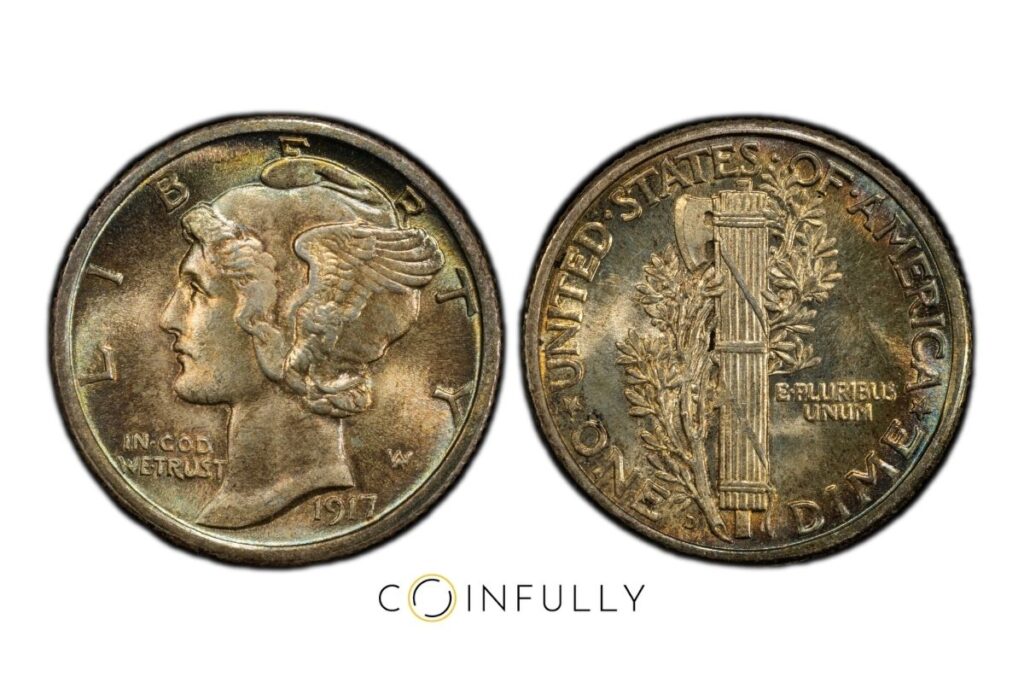
Introduced during a sweeping redesign of American coinage, the Mercury dime reflects the United States Mint’s early 20th-century push toward more artistic and symbolic designs.
The coin was produced from 1916–1945, replacing the Barber dime and signaling a departure from rigid, utilitarian imagery.
Although commonly associated with the Roman god Mercury, the figure actually represents Lady Liberty, with wings symbolizing freedom of thought. This misunderstanding led to the enduring nickname that still defines the series today.
Designed by Adolph A. Weinman, the same man who designed the Walking Liberty half dollar, the dime quickly gained public approval for its elegance and modern feel.
As the Mercury dime was minted through World War I, the Great Depression, and World War II, it became part of everyday commerce while also laying the foundation for one of the most studied and collected silver dime series in U.S. numismatics.
Coin Obverse
The obverse depicts Liberty facing left, wearing a winged Phrygian cap that led many to associate the design with the Roman god Mercury. This imagery caused the coin to be widely referred to as the Winged Liberty Head dime.
Weinman’s initials appear discreetly near the truncation of Liberty’s neck, while the date is positioned prominently at the lower rim.
The design emphasizes movement and clarity, making wear patterns easy to evaluate when a Mercury dime is graded, especially in higher-condition examples.
Coin Reverse
The reverse features a fasces, an ancient Roman symbol of unity and authority, paired with an olive branch to represent peace. The vertical fasces is wrapped with horizontal bands, a critical area for collectors assessing strike quality.
When the horizontal bands on the fasces are fully separated, the coin may qualify for the Full Bands designation, or FB, by grading services.
Strong definition in the fully separated horizontal bands on the reverse fasces can significantly increase its value, particularly for Mercury dimes graded at levels such as MS65 or higher.
Other Rare and Valuable U.S. Dimes
While Mercury dimes are among the most collected silver dimes, several earlier and later U.S. dime series contain issues that are equally important to American numismatic history.
These valuable dimes stand out for their limited mintages, historical context, and distinctive designs, with certain dates commanding significant premiums due to rarity and collector demand.
Draped Bust Dimes
Struck from 1796 to 1807, Draped Bust dimes represent the first silver dimes issued by the United States. Designed by Robert Scot, they feature Liberty with flowing hair on the obverse and a small eagle or heraldic eagle on the reverse, depending on the year.
Key dates include the extremely rare 1796 and 1797 issues, which are highly prized due to low survival rates and early minting challenges.
Capped Bust Dimes
Produced from 1809 to 1837, Capped Bust dimes were designed by John Reich and later modified by William Kneass. The obverse shows Liberty wearing a cap, while the reverse features an eagle with a shield.
Collectors closely watch early dates and certain low-mintage years, as some varieties, such as the 1828 Capped Bust dime, and early issues are difficult to locate in higher grades.
Seated Liberty Dimes
Minted from 1837 to 1891, Seated Liberty dimes depict Liberty seated on a rock holding a shield and pole. Christian Gobrecht’s design evolved over decades, with changes in stars, arrows, and legends.
Notable key dates include the 1871-CC and 1873-CC, which are scarce due to limited production at the Carson City Mint.
Barber Dimes
Barber dimes were struck from 1892 to 1916 and were designed by Charles E. Barber. The obverse features a classical portrait of Lady Liberty, while the reverse displays a wreath surrounding the denomination.
Several early San Francisco and New Orleans issues, particularly from the 1890s, are considered key dates and are highly sought after by collectors interested in valuable Barber dimes.
Roosevelt Dimes
Introduced in 1946 to honor President Franklin D. Roosevelt, Roosevelt dimes remain in production today. Early silver issues from the late 1940s and 1950s are collectible, especially lower-mintage years and well-preserved examples.
While most dates are common, certain proofs and error varieties attract steady interest among collectors.
How To Determine Mercury Dime Coin Value
Determining the value of a Mercury dime or other dimes worth money requires careful evaluation of several physical and market-related factors rather than relying on generic estimates.
Start by identifying the date and mintmark. Then, closely examine the coin for wear on high points, overall sharpness, and surface quality. Strike strength and originality can greatly influence desirability, especially for pieces that appear lightly circulated.
Professional appraisal and grading provide the most reliable assessment, as it accounts for condition, authenticity, and market standards.
Because demand fluctuates, accurate valuation also depends on current collector interest and recent verified transactions, making expert review essential before selling.
Lastly, knowing where to sell Mercury dimes matters more than you might think, as many venues carry risks and lead to lowball offers. Research options carefully before committing to a sale.
Get a Free Coin Appraisal From Coinfully
Coinfully offers a free online coin appraisal that lets you discover what your Mercury dimes or other coins may be worth without any pressure to sell.
You simply provide clear photos or an inventory of your coins, and one of our numismatic experts will evaluate them using current market conditions and trends to deliver a detailed appraisal at no cost to you.
The process is zero pressure and can be done entirely from home, so you remain in control throughout the entire experience.
For larger or historically important collections, we also provide a white-glove at‑home coin appraisal service. A qualified expert will travel to your location to assess your coins in person, answer your questions, and make a top‑of‑market offer that you are free to accept or decline.
This concierge‑style service is designed to be efficient, transparent, and respectful of your time, and it is completely unique to Coinfully. You won’t find this option offered anywhere else.
Whether you want to sell coins online or in person, getting a professional appraisal from Coinfully gives you confidence in your collection’s documented value and positions you to make informed decisions about selling, insuring, or preserving your coins for the future.
Reach out to Coinfully today to learn how much your Mercury dimes are truly worth.
Whether you have a single valuable coin, a personal collection of valuable gold and silver coins, or a large estate collection, you’ll receive personalized service, detailed answers to your questions, accurate appraisals, and the best price for your collection.
The post 10 Most Valuable Mercury Dimes: Value Guide for Collectors appeared first on Coinfully - the Best Way to Sell Coins | Free Appraisals.
Original post here: 10 Most Valuable Mercury Dimes: Value Guide for Collectors


Comments
Post a Comment