10 Most Valuable Seated Liberty Dimes (1837–1891): Value Guide
The most valuable Seated Liberty dimes are the following:
- 1874-CC Liberty Seated Dime: $4,500–$100,000
- 1873-CC Seated Liberty Dime: $2,500–$90,000
- 1871-CC Liberty Seated Dime: $2,500–$37,000
- 1872-CC Liberty Seated Dime: $500–$18,500
- 1846 Liberty Seated Dime: $120–$8,500
- 1860-O Seated Liberty Dime: $325–$8,000
- 1885-S Liberty Seated Dime: $400–$4,000
- 1859-S Liberty Seated Dime: $100–$4,000
- 1865-S Liberty Seated Dime: $65–$2,200
- 1866 Liberty Seated Dime: $450–$2,100
Seated Liberty dimes represent one of the most historically rich and complex silver coin series in American numismatics. Struck during a transformative period in U.S. history, these coins vary widely in rarity, condition, and value, with certain dates commanding exceptional premiums.
If you’re a coin collector and think you’re ready to sell Seated Liberty dimes from your collection, Coinfully makes it easy with free coin appraisals, top-market offers, and fast, secure payments. Contact Coinfully today to speak with one of our numismatic experts to learn more.
You can also download our free Instant Value Guide to see for yourself how much these coins are worth.
The Seated Liberty Dime (1837–1891)
The Liberty Seated dime is a classic United States silver coin issued continuously from 1837 through 1891, spanning more than five decades of economic change and westward expansion.
Throughout its run, dimes were produced at multiple mints and circulated widely in everyday commerce. Collectors today encounter a broad range of values driven by scarcity, preservation, and demand.
Common examples in circulated condition remain accessible, while coins in mint state or from scarce branch mints can be worth thousands, making the series appealing to both entry-level enthusiasts and advanced collectors.
If you want to explore other collectible dimes from different series, take a look at our insights into valuable dimes worth collecting.
Most Valuable Seated Liberty Dime: 1873 CC No Arrows
The most valuable Seated Liberty dime is the 1873-CC “No Arrows” dime, which is the sole survivor of a melted-down mintage. This coin sold for a staggering $3.6 million in 2023, making it a one-of-a-kind rarity and the ultimate prize for collectors of this series.
Following the Coinage Act of 1873, which changed silver content, the U.S. Mint ordered nearly all Carson City (CC) dimes melted, including the “No Arrows” variety, which was meant to have arrows but didn’t due to a die error.
Only one known example exists, making it the most valuable dime ever minted.
1874 CC Liberty Seated Dime
The 1874-CC Liberty Seated dime is one of the most valuable Liberty dimes, prized for its extremely limited survival, particularly in higher grades. Struck during a period of declining silver usage in the West, many examples saw heavy circulation or were later melted.
The 1874-CC was minted at the Carson City Mint, which is known for the Comstock Lode. This adds a layer of historical significance and allure to the coin.
Most known specimens show significant wear, making sharply detailed pieces exceptionally rare and highly sought after by advanced collectors of Carson City coinage.
Quick Breakdown: 1874-CC Liberty Seated Dime

Year: 1874
Mint Location: Carson City
Mintage: 10,817
Price Based on Condition:
- Low: $4,500
- High: $100,000
Image Credit: Numismatic Guaranty Company
1873 CC Seated Liberty Dime
The 1873-CC Liberty Seated dime stands out due to its association with major changes in U.S. silver coinage during that year. Production was brief, and survival rates are low, especially for problem-free examples.
Many were lost to circulation or melting following weight adjustments, leaving relatively few collectible specimens available today, particularly in mid to higher grades.
Quick Breakdown: 1873-CC Seated Liberty Dime

Year: 1873
Mint Location: Carson City
Mintage: 12,400
Price Based on Condition:
- Low: $2,500
- High: $90,000
Image Credit: Professional Coin Grading Service
1871 CC Liberty Seated Dime
As one of the earliest dimes struck at the Carson City Mint, the 1871-CC issue carries strong historical significance. The mint was still establishing operations, and production totals were modest.
Heavy circulation in the frontier economy left most examples well worn, making any coin with clear details a standout within the Seated Liberty dime series.
In higher grades, this coin can sell for large sums of money. For example, in 2014, an MS65 coin from the Eugene Gardner Collection sold for a record price of $270,250.
- Year: 1871
- Mint Location: Carson City
- Mintage: 20,100
- Price Based on Condition:
- Low: $2,500
- High: $37,000
1872 CC Liberty Seated Dime
The 1872-CC Liberty Seated dime is notable for its scarcity across all grades. Output remained limited at Carson City, and few examples escaped prolonged circulation.
This issue is consistently challenging to locate with strong eye appeal, and demand remains high due to its status as a foundational Carson City dime within the series. On average, these coins sell for around $1,050. The condition of the coin greatly impacts its selling price.
- Year: 1872
- Mint Location: Carson City
- Mintage: 35,480
- Price Based on Condition:
- Low: $500
- High: $18,500
1846 Liberty Seated Dime
The 1846 Liberty Seated dime is valued for its low production and early placement within the series. Struck only at Philadelphia, it saw widespread circulation during a period of strong demand for small silver coins.
High-grade survivors are scarce, and even moderately preserved examples are closely pursued by collectors assembling complete date sets.
- Year: 1846
- Mint Location: Philadelphia
- Mintage: 31,300
- Price Based on Condition:
- Low: $120
- High: $8,500
1860 O Seated Liberty Dime
The 1860-O Liberty Seated dime marks the introduction of the Legend Obverse design and was struck exclusively at the New Orleans Mint. It was one of the last few coins minted in the New Orleans Mint for several decades, as the mint closed in 1861 during the lead-up to the Civil War.
Many examples were heavily circulated in the South prior to the war, resulting in limited surviving quantities. Its historical context and design transition contribute to its enduring collector appeal.
- Year: 1860
- Mint Location: New Orleans
- Mintage: 40,000
- Price Based on Condition:
- Low: $325
- High: $8,000
1885 S Liberty Seated Dime
The 1885-S Seated Liberty dime is one of the lowest mintage issues from the San Francisco Mint. Relatively few were saved at the time of issue, and most surviving examples show moderate wear.
Coins with strong detail or original surfaces are particularly scarce, making this date a consistent standout among late-series Seated Liberty dimes.
While average-condition examples sell for around $400, high-quality coins can command prices as high as $4,000. Exceptional specimens have even crossed the $10,000 mark.
- Year: 1885
- Mint Location: San Francisco
- Mintage: 43,690
- Price Based on Condition:
- Low: $400
- High: $4,000
1859 S Liberty Seated Dime
As the first dime struck at the San Francisco Mint, the 1859-S Liberty Seated dime carries significant historical importance. Many were used extensively during California’s expanding commercial economy, leading to heavy wear.
Well-preserved examples are elusive, and the coin remains a cornerstone for collectors seeking or focusing on first-year mint issues.
- Year: 1859
- Mint Location: San Francisco
- Mintage: 60,000
- Price Based on Condition:
- Low: $100
- High: $4,000
1865 S Liberty Seated Dime
The 1865-S Seated Liberty dime was struck shortly after the Civil War, during a period of limited silver circulation on the West Coast. Production totals were modest, and most examples entered circulation immediately.
Higher-grade survivors are scarce, and demand remains strong due to the coin’s combination of age, rarity, and historical setting. On average, it sells for between $65 and $2,200.
- Year: 1865
- Mint Location: San Francisco
- Mintage: 175,000
- Price Based on Condition:
- Low: $65
- High: $2,200
1866 Liberty Seated Dime
The 1866 Seated Liberty dime is notable for its limited availability and low survival rate. Although struck at Philadelphia, relatively few examples were preserved, and most exhibit noticeable wear.
Its postwar context and scarcity in well-detailed condition make it a challenging and desirable addition for collectors building comprehensive Seated Liberty dime sets.
Interestingly, some 1866-S Seated Liberty dimes, which are not as scarce, are incorrectly sold as 1866 issues because the mintmark has been rubbed off over time.
- Year: 1866
- Mint Location: Philadelphia
- Mintage: 8,725
- Price Based on Condition:
- Low: $450
- High: $2,100
While the dimes listed here are considered to be the most valuable, other issues can bring strong prices as well, depending on condition.
These include the 1843-0 Liberty Seated dime, the 1844 Liberty Seated dime, the 1856-S Liberty Seated dime, 1858-S Liberty Seated dime, the 1861-S Liberty Seated dime, and the 1862-S Liberty Seated dime.
Factors That Determine Liberty Seated Dime Value
Liberty Seated dime values are shaped by a combination of physical condition, rarity, and market demand rather than silver content alone.
Understanding how these factors interact allows collectors and sellers to accurately assess why some examples trade for modest sums while others command substantial premiums.
Coin Condition
Condition is the single most important driver of value, as visible signs of wear directly affect desirability.
Coins in lower grades show flattened details on Liberty’s gown, shield, and the cap on top of the pole, while higher-grade Seated Liberty dime examples retain sharper design elements.
Pieces in extremely fine or better condition preserve strong detail across all parts of the design, significantly increasing market interest.
Grading by PCGS or NGC
Having a coin graded by a respected third-party service provides an objective assessment of authenticity and condition. Once a coin is graded and encapsulated by PCGS or NGC, buyers can compare it reliably against similar examples.
Certified pieces are easier for dealers and collectors to evaluate, and they often realize higher prices due to increased confidence and standardized grading terminology.
Year, Mintage, and Mintmark
The date and mint strongly influence scarcity and value, particularly for issues with low original production. Certain Carson City struck dimes and other rare dates qualify as key dates due to limited survival today.
When dimes were produced in smaller numbers or at short-lived branch mints, demand consistently outweighs supply, driving premiums well above common issues.
Silver Content of Liberty Seated Dimes
Unlike modern copper-nickel clad dimes, Seated Liberty dimes contain 90% silver and 10% copper. Although these dimes contain precious metal, their worth typically exceeds bullion value due to numismatic demand.
Metal content establishes a base level, but collector interest determines the true range of values. Coins in uncirculated condition or from highly sought-after years trade well above melt value, reflecting rarity and historical significance rather than silver alone.
History of the Seated Liberty Dime
The Seated Liberty dime was introduced in 1837 as part of a broader redesign of United States silver coinage, replacing the earlier Bust dime and establishing a distinctly classical aesthetic.
Early issues reflected evolving standards, and dimes were struck under several adjustments tied to a change in weight and economic pressures on circulating silver.
From 1853 to 1855, arrows were added to the date to indicate revised specifications, while later pieces returned without arrows once stability was restored.
Over time, the series expanded to include multiple mints, creating a wide spectrum of dates and varieties that remain central to numismatic study.
Production continued until 1891, when the Barber design replaced it, closing a chapter that produced some of the nation’s most studied silver dimes. Be sure to check out our guide on valuable Barber dimes.
Seated Liberty Dime Design
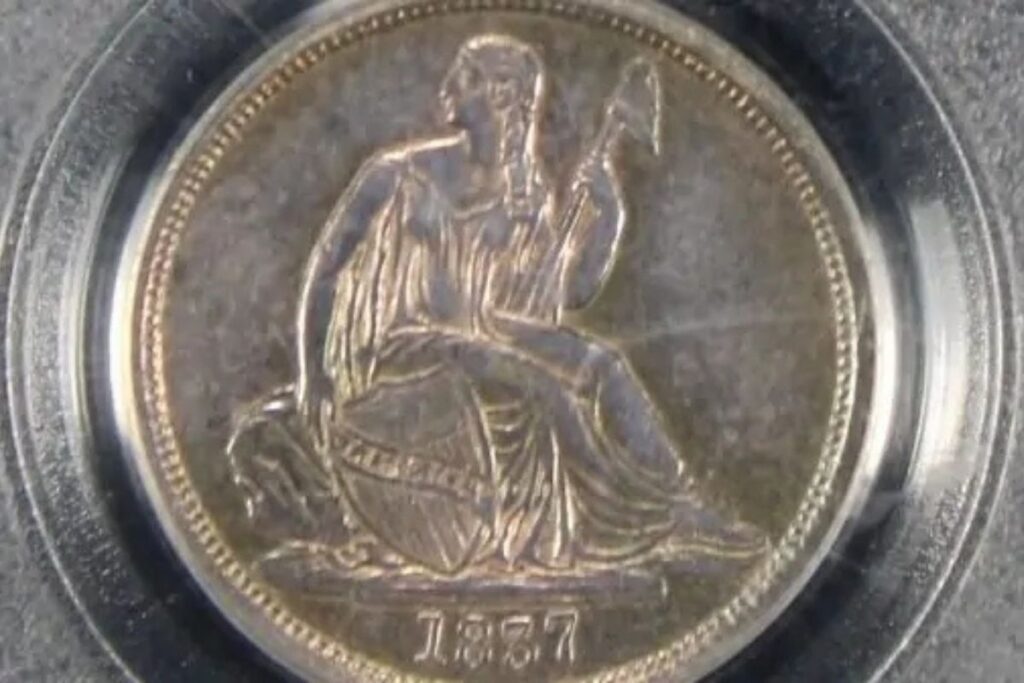
The Seated Liberty design debuted in 1837 and remained in use across the Seated dime series for more than half a century, making it one of the longest-running motifs in United States silver coinage.
Created by chief engraver Christian Gobrecht, the design replaced the earlier Bust series and reflected a shift toward neoclassical symbolism.
Variations of the same figure appeared on the half dime, quarter dollar, half dollar, and dollar, with periodic modification to weight standards, inscriptions, and diagnostic features.
Obverse
The obverse design features the figure of Lady Liberty seated on a rock, facing left, holding a shield in one hand and holding a pole topped with a liberty cap symbolizing freedom in the other.
Thirteen stars surround the central figure on many issues, representing the original states. Later versions introduced changes such as added legends or arrows at the date, reflecting adjustments tied to silver weight and federal coinage laws.
Reverse
The reverse of the coin displays a simple wreath encircling the denomination, marked as ONE DIME. The inscription is placed within the wreath, with the bow of the wreath positioned at the bottom. Clearly defined edges of the leaves make the design stand out.
On most issues, the mintmark is located on the reverse beneath the wreath, with its placement remaining consistent across later types.
Types of Seated Liberty Dimes
The Seated Liberty dime series includes distinct design phases that help collectors and researchers identify coins by era and style. Each major type reflects subtle changes in the obverse and reverse that correspond to regulatory updates and aesthetic adjustments made from 1837 through 1891.
Recognizing these major varieties is essential before studying individual dates and mintmarks. If you’d like to learn more about other valuable dimes, see our guide on valuable Mercury dimes.
No Stars Obverse (1837–1838)
The No Stars Obverse type represents the earliest Seated Liberty dimes, with Liberty’s figure alone on the obverse with no stars surrounding her.
These issues were struck at the Philadelphia and New Orleans mints, with the O mintmark on the reverse within the wreath for New Orleans examples.
Few were produced, and original mintage numbers remain limited, making this type a foundational collectible among early silver dimes.
Stars Obverse (1838–1860)
The Stars Obverse type introduced 13 stars around the perimeter of the obverse, marking the original states and echoing earlier U.S. coinage traditions.
The Stars variety was struck by Philadelphia (no mintmark), New Orleans (O), and San Francisco (S), with mintmarks found within the wreath on the reverse.
The Stars Obverse Seated Liberty dime accounts for the largest single block of production before later design changes took effect.
Arrows at Date (1853–1855)
In the Arrows at Date variation, small arrow symbols flank the date on the obverse to signal a federal change in the dime’s weight standard. These issues were primarily Philadelphia issues and continued the Stars Obverse design elsewhere.
Mintmarks remain on the reverse within the wreath for branch mint issues. This subtype is important for identifying weight-adjusted Seated Liberty dime varieties.
Legend Obverse (1860–1891)
The Legend Obverse type replaced the stars on the obverse with the full United States of America legend. On the reverse, the wreath size was enlarged to fill the void.
This new Seated Liberty dime design was produced at Philadelphia (no mintmark), New Orleans (O), San Francisco (S), and Carson City (CC), with mintmarks below the wreath on the reverse. In total, over 175 million of the Legend Obverse Seated Liberty dimes were produced from 1860 through 1891, and it is the longest-running major type in the series.
Arrows at Date (1873–1874)
A second Arrows at Date subset occurred within the Legend Obverse era to indicate another adjustment to weight specifications. Like the earlier arrows subtype, these coins show small arrows on either side of the date on the obverse.
They were struck by Philadelphia, San Francisco, and Carson City, with mintmarks located beneath the wreath on the reverse.
Large Date and Small Date Varieties
Within various Seated Liberty types, some years feature large date and small date variations, which refer to differences in the size and placement of the date numerals on the obverse.
These diagnostic sub-varieties often indicate distinct die sets and can affect a coin’s rarity and desirability among specialists. Mintmarks for these issues remain consistent with their parent types on the reverse below the wreath.
Seated Liberty Dime Mintmarks
Mintmarks on Seated Liberty dimes identify where the coin was struck and appear only on branch-mint issues. Depending on the type, the mintmark is located on the reverse, either within the wreath on earlier designs or below the wreath on later Legend Obverse dimes.
Philadelphia pieces carry no mintmark, while issues from the New Orleans, San Francisco Mint, and Carson City are clearly identified by their letters (O, S, and CC).
Scarcer branch-mint issues, particularly Carson City dimes, often command stronger premiums due to lower output and collector demand.
How To Determine Seated Liberty Dime Value
Determining the value of a Seated Liberty dime begins with a careful assessment of its condition, noting any signs of wear, scratches, or damage. Next, identify the date and mintmark to establish rarity, as certain branch-mint issues and low-mintage years are more valuable.
Consulting recent auction results, dealer price guides, and professional grading services can provide context for current market trends and introduce you to other dimes worth money.
A formal coin appraisal offers an expert evaluation, confirming authenticity, condition, and estimated value, and is especially helpful when preparing to sell or insure a collection.
For higher-value or rare dates, professional grading can be a worthwhile investment, providing a certified condition that often increases sale potential. For lower-value coins, grading is generally unnecessary.
Thinking of Selling? How To Find a Trusted Dealer
When selling a Seated Liberty dime, it’s important to choose a reputable dealer to ensure fair pricing and secure transactions.
Local coin shops and pawn shops may offer convenience but often provide lower offers. Online marketplaces can expose sellers to scams, while auction houses may charge high fees and take time to sell.
The best place to sell valuable coins rusted, professional coin dealers and established numismatic firms provide transparent pricing, authentication, and expert guidance, reducing risk and maximizing the value received for rare or high-grade coins.
Get a Free Coin Appraisal With Coinfully
Coinfully provides two convenient ways to get an expert coin appraisal. Our free online appraisal lets you discover what your Seated Liberty dimes or other coins are worth without any pressure to sell.
Simply upload clear photos or provide an inventory of your coins, and one of our numismatic experts will fully evaluate them and deliver a detailed appraisal at no cost to you.
For larger or historically significant collections, we offer a concierge at-home appraisal service, where a numismatic expert travels to your location, evaluates each item in detail, and makes a competitive offer immediately.
Both services prioritize transparency, authentication, and ease, ensuring collectors feel confident and informed about their coins’ worth.
By taking advantage of professional appraisal services, you gain a clear understanding of the market value for your Seated Liberty dimes and other rare coins.
Interested in learning the true value of your collection? Contact Coinfully today to get started.
The post 10 Most Valuable Seated Liberty Dimes (1837–1891): Value Guide appeared first on Coinfully - the Best Way to Sell Coins | Free Appraisals.
Original post here: 10 Most Valuable Seated Liberty Dimes (1837–1891): Value Guide


Comments
Post a Comment