10 Valuable Bust Dollars: Flowing Hair & Draped Bust Dollar Values
The most valuable Bust dollars include:
- 1794 Flowing Hair Dollar: $35,000–$10,000,000
- 1804 Draped Bust Dollar (Class I): $2,000,000–$7,680,000
- 1795 Flowing Hair Dollar (Three Leaves): $100,000–$1,000,000+
- 1801 Draped Bust Dollar: $1,100–$350,000
- 1802 Draped Bust Dollar: $800–$300,000
- 1796 Draped Bust Dollar: $750–$300,000
- 1797 Draped Bust Dollar (9×7 Stars): $750–$300,000
- 1798 Draped Bust Dollar (Small Eagle): $750–$250,000+
- 1799 Draped Bust Dollar: $750–$400,000
- 1800 Draped Bust Dollar: $750–$396,000
The most valuable Bust dollars are those from low-mintage early dates with poor survival rates, especially issues from 1794 through 1802 and the legendary 1804 Draped Bust dollar, which commands prices measured in the millions.
Early U.S. silver dollars occupy a special place in American numismatics, and few are more coveted than Flowing Hair and Draped Bust issues.
Struck during the nation’s earliest years, these coins saw heavy circulation and were rarely preserved, making surviving examples highly desirable today.
For collectors, understanding which early dollars are most valuable and why requires knowledge of history, rarity, condition, and market demand. This guide breaks down the most valuable Bust dollars and explains what drives their exceptional worth.
If you’d like to know the true value of your rare coins or are wanting to sell a Bust dollar from your collection, contact Coinfully today for a free online coin appraisal.
1794 Flowing Hair Silver Dollar

Year: 1794
Mint Location: Philadelphia
Mintage: 1,758
Price Based on Condition:
- Low: $35,000
- High: $10,000,000
Image Credit: USA Coin Book
At the top of our list is the 1794 Flowing Hair dollar, the very first silver dollar issued by the U.S. federal government. Production of these coins was authorized by the Coinage Act of 1792, but due to technical issues and silver shortages, production was delayed until 1794.
This coin is highly valuable due to its historical significance and rarity. With only 1,758 coins minted, estimates suggest that just 125–150 examples survive today. It is considered to be among the most valuable U.S. coins.
A circulated 1794 Flowing Hair silver dollar coin is worth around $100,000, while mid-grade examples can fetch $1,000,000. In 2013, a pristine specimen set a world record by selling for $10,016,875, marking the first time a rare coin had surpassed $10 million at auction.
1804 Draped Bust Dollar (Class I)

Year: 1804
Mint Location: Philadelphia
Mintage: 15
Price Based on Condition:
- Low: $2,000,000
- High: $7,680,000
Image Credit: Professional Coin Grading Service
Often referred to as the “King of American Coins,” the 1804 Draped Bust dollar (Class I) has legendary status among coin collectors. Only eight of these coins are known to still exist today.
The year is deceiving because these coins were actually produced in 1834 under the direction of Chief Coiner Adam Eckfeldt. They were created as diplomatic gifts to foreign heads of state from President Andrew Jackson.
It’s hard to value these coins because so few exist today and their condition varies greatly. In 2021, one fine specimen sold for $7,680,000 at auction.
1795 Flowing Hair Dollar (Three Leaves)

Year: 1795
Mint Location: Philadelphia
Mintage: estimated between 160,295 and 290,000
Price Based on Condition:
- Low: $100,000
- High: $1,000,000+
Image Credit: Professional Coin Grading Service
Next up, we have the 1795 Flowing Hair silver dollar in the Three Leaves variety. While this is considered more common than other 1795 dollar varieties, such as the 1795 Off-Center Bust variety, it’s still exceptionally rare, especially in higher grades.
This variety features three leaves under the eagle’s wings on the reverse of the coin. It also depicts larger leaves, bigger stems, and a wider ribbon than the other varieties.
The auction record for this coin was $1,265,000 in 2005; however, the price can vary greatly depending on coin condition. In heavily circulated condition, it can sell for around $2,380.
1801 Draped Bust Dollar

Year: 1801
Mint Location: Philadelphia
Mintage: 54,454
Price Based on Condition:
- Low: $1,100
- High: $350,000
Image Credit: Professional Coin Grading Service
The 1801 Draped Bust dollar is another highly sought-after Bust dollar. With a low mintage of 54,454, the rarity of this coin makes it highly valuable.
In average condition, this coin can sell for around $1,100 to $4,600, with the value jumping significantly for uncirculated specimens. The auction record for this coin was $329,000 in 2013.
1802 Draped Bust Dollar

Year: 1802
Mint Location: Philadelphia
Mintage: 41,650
Price Based on Condition:
- Low: $800
- High: $300,000
Image Credit: Professional Coin Grading Service
The 1802 Draped Bust dollar is another rare and elusive United States dollar coin, partly due to its misguided mintage. The reported mintage is inaccurate from its actual mintage, which is estimated to be around 80,000.
Very few mint-condition examples of this coin survive today, which adds to its value. Its auction record sits at $300,000 from 2020. However, you can expect lower-grade coins to sell for around $1,000.
1796 Draped Bust Dollar

Year: 1796
Mint Location: Philadelphia
Mintage: 79,920
Price Based on Condition:
- Low: $750
- High: $300,000
Image Credit: Professional Coin Grading Service
As the first year of the Draped Bust variety, the 1796 issue is highly valuable and sought after. It’s rare in any condition, especially in Mint State and Uncirculated grades, which adds significant value to the coin.
There are three varieties of this coin, based on the size of the dates and letters. The auction record was set at $352,500 in 2013 for a small-date, large-letters variety.
In circulated condition, this coin can be worth around $31,000 to $240,000, making it one of the most valuable circulated coins on this list.
1797 Draped Bust Dollar (9×7 Stars)

Year: 1797
Mint Location: Philadelphia
Mintage: 7,776
Price Based on Condition:
- Low: $750
- High: $300,000
Image Credit: Professional Coin Grading Service
The 1797 Draped Bust dollar is another rare U.S. dollar coin. There are two varieties of this particular coin based on the size of the lettering.
The “9×7 stars” refers to the unique arrangement of stars on the obverse, where there are nine stars on the left side of Liberty’s profile and seven on her right. This coin is highly valuable, with its auction record set at $381,875 in 2013.
1798 Draped Bust Dollar (Small Eagle)

Year: 1798
Mint Location: Philadelphia
Mintage: 327,536 (all varieties)
Price Based on Condition:
- Low: $750
- High: $250,000+
Image Credit: Professional Coin Grading Service
The 1798 Draped Bust dollar is another rare and valuable Bust dollar. In particular, the version that features a small eagle on the reverse instead of the later heraldic eagle is highly valuable and sought after.
It’s thought that only around 3% of these coins still exist today. Recently, auction prices have ranged from around $1,200 to $31,500, depending on condition. However, they have been known to sell for much more.
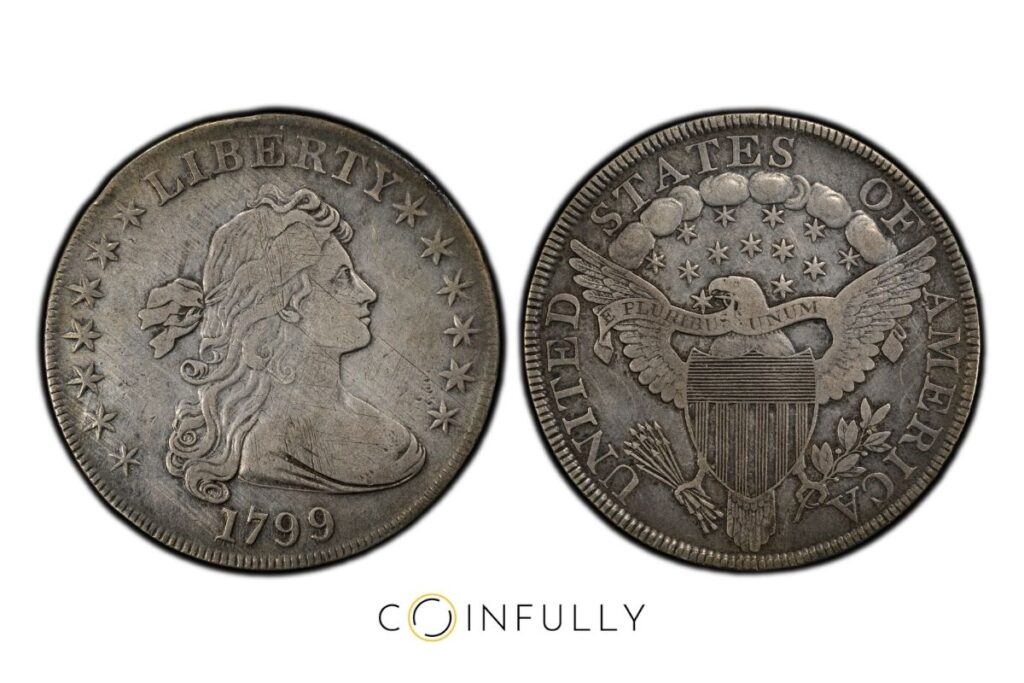
1799 Draped Bust Dollar

Year: 1799
Mint Location: Philadelphia
Mintage: 423,515
Price Based on Condition:
- Low: $750
- High: $400,000
Image Credit: Professional Coin Grading Service
The 1799 Draped Bust dollar is another dollar coin worth serious money. This variant has one of the highest mintages on this list due to the U.S. Mint increasing production for that year.
There are a few key varieties of this coin that add to its value. Keep an eye out for any overdates or differing star arrangements, as these factors could increase the value by thousands of dollars.
1800 Draped Bust Silver Dollar

Year: 1800
Mint Location: Philadelphia
Mintage: 220,920
Price Based on Condition:
- Low: $750
- High: $396,000
Image Credit: Professional Coin Grading Service
To round off our list, the 1800 Draped Bust dollar represents the turn of the century for U.S. coin production. This fact coupled with their rarity make these coins particularly sought after by collectors.
In average circulated condition, this coin can be worth around $1,445. In uncirculated condition, you’re looking at more than $13,600. The highest grades of these coins sell for around $396,000.
Factors That Impact Flowing Hair & Draped Bust Dollar Value
Flowing Hair and Draped Bust dollars are among the earliest issues of U.S. silver coinage, and their values, like all other silver dollar values, are shaped by a combination of intrinsic metal worth and complex numismatic factors.
Understanding these drivers helps collectors and sellers accurately gauge market demand and pricing potential.
Silver Content
Each Flowing Hair and Draped Bust dollar contains roughly 0.7735 ounces of silver, giving it a baseline melt value tied to spot prices.
While silver content alone rarely defines overall worth, rising bullion markets can elevate demand for early federal issues, especially coins that have seen modest circulation rather than heavy damage.
Date and Die Varieties
All Bust dollars were struck at the Philadelphia Mint and lack mintmarks, making the date and specific die marriages critical. Small differences in dies can create meaningful variation in rarity, with certain dates far rarer than others.
Collectors closely study these nuances, as even subtle distinctions can significantly impact value due to documented scarcity.
Coin Condition
Condition is often the single biggest value driver. Bust dollars surviving in high grades are genuinely scarce, as most circulated heavily in the late 18th and early 19th centuries.
Coins graded XF or better command strong premiums, particularly when original surfaces with even wear and natural tone remain intact.
Grading by PCGS or NGC
Third-party grading provides essential market confidence for valuable Bust dollars. Coins authenticated and graded by PCGS or NGC are easier to sell and typically achieve higher prices, as buyers trust the accuracy and consistency of these services.
Certified examples often bring a meaningful premium compared to uncertified pieces.
Overdate and Other Varieties
Overdates and major design anomalies are highly sought after within the Bust dollar series. Issues with repunched dates, such as the famous 1799/8 Draped Bust dollar, or unusual die states can be rarer than standard strikes of the same year.
These varieties appeal strongly to advanced collectors and can dramatically increase value beyond what a standard pricing chart might suggest.
Bust Dollar Designs
The visual designs of early U.S. silver dollars reflect both artistic ambition and the practical realities of America’s first national currency.
Each major Bust dollar type introduced distinct design elements that signaled a maturing Federal Mint while responding to public taste, political symbolism, and production challenges.
Flowing Hair Dollar (1794–1795)
The Flowing Hair dollar was the first official silver dollar struck by the United States, introduced as a bold new design in the 1790s.
Designed by Mint Chief Engraver Robert Scot, the obverse features Liberty with long, flowing hair and 13 stars representing the original colonies, a symbol of independence and national unity.
The edge of the coin is lettered HUNDRED CENTS ONE DOLLAR OR UNIT with decorations between the words. On the reverse, an open wreath encloses a small eagle, emphasizing simplicity over ornamentation. This raw, expressive style gives the type enduring historic appeal.
How many flowing hair dollars exist? Only approximately 125–150 of the 1794 Flowing Hair silver dollars are thought to exist today, but several thousand of the 1795 Flowing Hair dollar coins are believed to have survived over the years.
The 1794 Flowing Hair dollar is usually near the top of any list highlighting dollar coins worth money.
Draped Bust Dollar Small Eagle Reverse (1795–1798)
The Draped Bust dollar replaced the earlier Flowing Hair motif with a more refined portrait based on a model attributed to Gilbert Stuart. The draped bust design shows Liberty with flowing drapery and softer facial features, reflecting European neoclassical influence.
The reverse retained a modest eagle within a wreath, similar in scale to earlier issues. This type bridges artistic experimentation and technical improvement during the formative years of U.S. coinage.
Draped Bust Dollar Heraldic Eagle Reverse (1798–1804)
Introduced in 1798, the Heraldic Eagle reverse marked a significant stylistic shift for the dollar series. Liberty’s obverse portrait remained largely unchanged, but the reverse adopted a larger, more formal eagle inspired by the Great Seal of the United States.
The shielded eagle, outstretched wings, and surrounding clouds conveyed strength and permanence. This redesign elevated the coin’s visual authority and aligned federal silver currency with national symbolism.
Bust Dollar Key Dates To Watch For
Several dates within the Bust dollar series stand out due to low mintages, heavy circulation, or limited surviving examples. Collectors closely monitor these issues because demand consistently exceeds available supply.
- 1794 Flowing Hair Dollar: The first year of issue and among the rarest early silver dollars.
- 1795–1798 Issues: Scarcity varies widely by die pairing, with certain varieties far rarer than others.
- 1801 and 1802 Draped Bust Dollars: Low production and poor survival rates drive strong collector interest.
- 1804 Draped Bust Dollar (Class I): Widely regarded as the rarest and most valuable U.S. silver dollar.
If you enjoy learning about valuable dollar coins, be sure to check out our guide on valuable Morgan dollars.
What To Do if You Own Valuable Bust Dollars
If you own valuable Bust dollars, start by handling them carefully and never cleaning them, as even light cleaning can permanently reduce value. Sort the coins by date and type, and gather any purchase records, past appraisals, or provenance documentation.
Obtain a professional appraisal to understand current market value, and consider third-party grading for higher-value examples, especially if you are considering selling your collection.
Learning how to sell silver coins and where to sell silver coins ensures you choose a secure, reputable selling method.
Get a Free Coin Appraisal With Coinfully
When you’re ready to understand what your Bust dollars and other rare coins are worth, Coinfully offers two convenient and transparent appraisal services, both with zero pressure to sell.
With our free online coin appraisal, you simply submit photos or an inventory listing of your coins from home.
Our team of numismatic experts uses the latest market data to assess rarity, condition, and value and then returns a detailed valuation you can use for insurance, estate planning, or selling. We’ll also include an offer to buy your coins, which you are free to accept or decline.
For large or historically significant collections, we also provide a concierge at-home appraisal service, where a numismatic expert travels to your location to inspect your coins in person and make a top-of-market offer on the spot.
This visit includes a transparent explanation of values and immediate payment if you choose to sell.
Either way, you get professional expertise without the stress and uncertainty of traditional in-store appraisals, and you remain in control of your collection every step of the way. Coinfully makes it easy to sell silver coins, all from the comfort of your own home.
Ready to get started? Contact Coinfully today to learn how much your coin collection is truly worth and receive a top-of-market offer.
The post 10 Valuable Bust Dollars: Flowing Hair & Draped Bust Dollar Values appeared first on Coinfully - the Best Way to Sell Coins | Free Appraisals.
Original post here: 10 Valuable Bust Dollars: Flowing Hair & Draped Bust Dollar Values


Comments
Post a Comment