Valuable Gold Coins: Which Gold Coins Are Worth the Most?
The most valuable gold coins are typically rare U.S. issues from the 19th and early 20th centuries, including Saint-Gaudens Double Eagles, early Liberty Head Eagles, and select Indian Head coins with low mintages or exceptional condition.
Coins with historic significance, original surfaces, and professional grading often sell for multiples above their gold content.
Are gold coins valuable? Yes. Some gold coins are worth only their metal content, while others can sell for tens of thousands or even millions of dollars due to rarity, condition, and historical significance.
From early U.S. gold dollars to the iconic Saint-Gaudens Double Eagle, this guide highlights the most valuable gold coins, explains what makes them rare and desirable, and provides practical advice for identifying, preserving, and potentially selling these extraordinary pieces.
If you’re considering whether or not to sell valuable gold coins from your collection, Coinfully can provide you with a detailed coin appraisal at no cost and with no obligation so you’ll know exactly what your coins are worth. Contact us today to speak with one of our numismatic experts.
What Makes a Gold Coin Valuable?
Gold coin values are determined by a combination of intrinsic worth and collector-driven demand. Understanding the driving factors helps explain why some pieces trade close to bullion prices while others become extremely valuable numismatic assets.
Gold Content (Melt Value)
Every gold coin has a baseline value derived from its gold content. This is often called melt value. Melt value is calculated using the coin’s weight and purity, whether it contains 90% gold, as with many historic U.S. issues, or .999 fine gold common to modern gold coins.
Melt value fluctuates with spot gold prices and establishes the minimum market price regardless of rarity or condition.
Rarity and Mintage Numbers
Rarity is driven by how many coins were originally produced and how many survive today. Low mintage figures, combined with high attrition from melting or circulation, create scarcity that attracts investors and collectors.
Certain dates, mintmarks, or short-lived issues within U.S. gold coinage are known for commanding premiums because demand far exceeds available supply.
Historical Significance
Gold coins tied to major events often carry added collector interest beyond metal value. Issues connected to the California Gold Rush, early federal minting, or pivotal periods in the history of American coinage reflect economic and cultural change.
Short-lived mint issues and coins struck during gold recalls or transitional years frequently become prized because they represent moments that can never be repeated.
Condition and Professional Grading by NGC or PCGS
Condition has a dramatic impact on value, particularly for collectible gold coins. Uncirculated examples and Proof coins with sharp strike quality, original surfaces, and strong eye appeal sell for far more than worn pieces.
Professional grading services certify authenticity and condition and assign standardized grades that give buyers confidence and often result in exponentially higher realized prices.
Bullion Gold Coins vs. Numismatic Gold Coins
Bullion gold coins are valued primarily for their gold content and closely track the spot price of gold. Common examples include American Gold Eagles and other modern gold coins produced in large quantities for investors.
Numismatic gold coins derive value from rarity, age, condition, and collector demand, often selling for substantial premiums above melt value.
Pre-1933 U.S. gold coinage, such as Liberty Head and Indian issues, falls into this category due to limited surviving populations and historical importance.

The Most Valuable Gold Coin Ever Sold
Only one gold coin stands above all others in terms of documented sale price, legal complexity, and historical importance. Its story reflects both the height of American gold coin production and the abrupt end of circulating gold currency in the United States.
St. Gaudens 1933 Double Eagle
The 1933 Saint-Gaudens Double Eagle was never officially released after President Roosevelt halted gold circulation, and nearly all examples were ordered melted.
A single specimen was later granted legal ownership status following a prolonged court battle with the U.S. government, making it the only privately owned example.
In 2021, it sold at auction for over $18 million, a record that underscores its status as the rarest and most valuable U.S. gold coin.
Most Valuable Gold Coins by Denomination
United States gold coins were issued in several denominations, each with its own series, rarity profile, and collector demand.
While many examples trade near melt value, specific dates, mint locations, and survival rates separate ordinary pieces from the most valuable U.S. gold coins ever sold.
Most Valuable Gold $1 Coin (Liberty Head and Indian Princess)
Gold dollar coins were minted from 1849 through 1889 with three main design types: Type 1 (Liberty Head), Type 2 (Small Head Indian Princess), and Type 3 (Large Head Indian Princess). They are the smallest and lightest regular-issue U.S. gold coins.
What dollar gold coins are valuable? It’s important to understand that their value is driven almost entirely by rarity rather than gold content.
Key dates for valuable gold dollar coins include the 1849-C Open Wreath, the 1855-D, and the 1875, which were all produced in very limited numbers.
Many gold dollars circulated heavily or were lost, leaving few high-grade survivors. Proof-only issues and sharply struck examples from the San Francisco and Charlotte mints command especially strong premiums when certified in top condition.
Most valuable one dollar coins vary widely in value, from around $100 for worn examples to hundreds of thousands for rare, pristine ones.
The current auction record for a $1 gold coin is for an 1849-C Open Wreath coin in Mint State condition, which sold for $1,560,000 in January 2025. See our guide about gold dollar coins worth money to learn more.
Most Valuable $2.50 Gold Coin (Quarter Eagles)
Quarter Eagles were struck in multiple designs between 1796 and 1929, with value concentrated in early issues and those with low mintage numbers.
The 1848 CAL. issue, struck using gold from the California Gold Rush and marked with a small “CAL.” punch, is one of the most famous and valuable examples. Other key dates include early Capped Bust issues and low-mintage Charlotte and Dahlonega coins.
Survival rates are low due to circulation and melting, making original, problem-free pieces highly sought after.
These $2.5 gold coins have a wide value range, from gold melt value price up to thousands of dollars for rare dates/mintmarks in pristine condition, with some key issues such as the 1911-D Indian Head reaching $20,000+ in uncirculated grades.
The most valuable $2.50 gold U.S. coins are the 1841 Liberty Head Quarter Eagle and the 1848 “CAL” Liberty Head Quarter Eagle, both of which can be valued well over a quarter of a million dollars in high grades and potentially over $1 million for the 1848 “CAL.”
Most Valuable $5 Gold Coin (Half Eagles)
Half Eagles enjoyed the longest production run of any U.S. gold denomination, spanning 1795 to 1929. Despite relatively higher mintages, certain issues are exceptionally scarce.
Carson City examples consistently command strong premiums due to limited production and Western mint demand.
Early Draped Bust and Capped Bust Half Eagles are rare in any grade, while later Indian Head issues with low survival rates attract strong competition. Coins with original surfaces and minimal wear see steep price increases as grade improves.
U.S. $5 gold coin value varies immensely, from around $500–$800 for modern 1/10 oz American Gold Eagles to potentially millions for rare, early U.S. Draped Bust gold coins.
Most 19th/early 20th-century $5 Liberty gold coin examples and Indian Head $5 “Half Eagles” fall in the $1,000 to tens of thousands range.
The auction record for a gold 5 dollar coin is $8.4 million, set by an 1822 Half Eagle in March 2021.
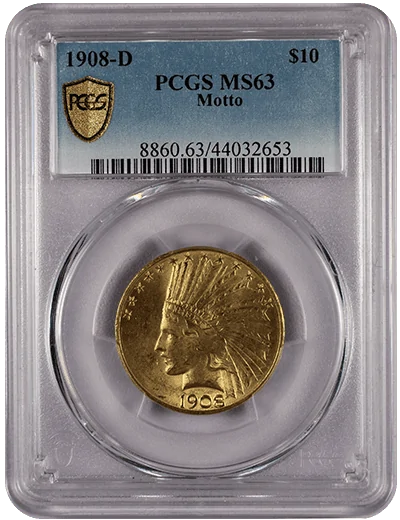
Most Valuable $10 Gold Coin (Eagles)
Gold Eagles were minted from 1795 to 1933 and include several design types with vastly different rarity levels. Early issues from the late 18th and early 19th centuries are extremely scarce and often exist only in low grades.
Among later coins, certain mintmarked Indian Head Eagles stand out for ultra-low mintages and limited surviving populations.
Proof Eagles are especially rare, as they were struck in small numbers for collectors and rarely preserved, making them cornerstones of advanced collections.
The value of a 10 dollar gold coin varies wildly, from around $1,300–$2,300 for modern bullion (such as the 1/4 oz Gold Eagle) to tens or hundreds of thousands for rare, old Liberty or Indian Head coins, depending heavily on the specific coin and the current gold price.
The auction record for a $10 gold coin is currently $2,185,000.00, set by a Proof 1907 Indian Head Rolled Edge specimen in 2011.
Most Valuable $20 Gold Coins (Double Eagles)
Double Eagles were introduced in 1850 and became the backbone of U.S. gold commerce until gold circulation ended in 1933.
While many Liberty Head $20 gold coin examples remain available, specific dates and mints are genuinely rare, particularly early San Francisco issues.
Saint-Gaudens Double Eagles are prized for their design and historical importance, with select dates commanding enormous premiums. If you own any of these coins, it’s essential to know how to sell St. Gaudens Double Eagles for top dollar.
The discovery of the Kentucky Hoard reshaped availability for some dates, though truly rare examples remain difficult to obtain and are highly valued.
$20 gold coins range wildly in value, from just over gold melt value for common dates in lower grades to millions for rare issues such as the 1933 Saint-Gaudens or certain high-grade Liberty Head rarities (e.g., 1854-O and 1870-CC).
How Much Are Gold Coins Worth Today?
The value of gold coins today depends on both the latest gold prices and collector demand. Common U.S. gold coins often trade at modest premiums above melt value, which varies by denomination based on weight and purity.
Scarce dates, high-grade examples, and coins with exceptional eye appeal can sell for many times their intrinsic gold content.
Precious metal markets and numismatic demand can shift quickly, meaning prices are not guaranteed and may change without notice. For rare coins, recent auction results and professional appraisals provide more reliable guidance than daily spot prices alone.
Are Gold Coins a Good Investment?
Gold coins can serve different purposes depending on the buyer’s objectives. Bullion coins appeal to investors seeking exposure to precious metal prices, while rare coins attract collectors focused on long-term scarcity, beauty, and condition.
Historically, numismatic gold has rewarded patience rather than short-term speculation, with performance tied to rarity, demand, and preservation quality.
Unlike stocks or bonds, gold coins do not produce income, so their value is realized only upon sale, making careful selection and proper storage essential.
Gold Coins Worth Money That Collectors Should Watch For
Many valuable gold coins for collectors remain attainable for those who focus on smart selection rather than headline rarities.
Pre-1933 U.S. gold coins with moderate mintages, such as common-date $5 and $10 pieces in lightly circulated condition, offer strong historical interest without extreme prices.
Certain early Liberty Head issues, lower-grade Indian Head coins, and well-preserved gold dollars also appeal to collectors building depth over time. Emphasis should be placed on originality, balanced wear, and problem-free surfaces rather than chasing the highest grades.
How To Tell If You Have a Valuable Gold Coin in Your Collection
Determining whether a U.S. gold coin is valuable begins with examining the year and mintmark, which identify rarity and production location. Coins from low-mintage years or historic mints such as Carson City or Charlotte often carry significant premiums.
Check both the obverse and reverse for signs of damage or wear. Avoid cleaning or polishing, as surface damage dramatically reduces value.
Online estimates can be misleading because they rarely account for condition, strike quality, or market fluctuations. Professional appraisal or third-party grading from NGC or PCGS is recommended for high-potential coins.
A certified evaluation not only confirms authenticity but also assigns a standardized grade, providing confidence for collectors considering sale, insurance, or long-term investment.
What To Do If You Own Valuable Gold Coins
If you own valuable gold coins, careful management is essential to protect their worth.
- Decide whether to keep them as long-term investments or sell based on market conditions and personal goals.
- Ensure coins are stored securely in a safe or bank vault to prevent theft or environmental damage.
- Obtain professional appraisal to establish current value, and consider having extremely valuable pieces graded to certify authenticity and condition.
- Insurance coverage is recommended, and documenting coins within estate planning can preserve wealth for heirs.
- Avoid cleaning or handling coins excessively, as even minor damage can reduce their value.
- Knowing where to sell gold coins is as important as knowing how to sell gold coins. Research buyers and terms carefully.
Sell Gold Coins the Smart Way With Coinfully
If you are thinking of selling gold coins, Coinfully offers a free online appraisal service that helps you understand the value of your coins without obligation.
You simply submit photos or an inventory listing, and our numismatic team evaluates your coins using current market data and industry expertise. This certified appraisal can be used for insurance, estate planning, or sale decisions with no cost to you.
For larger or historically significant collections, Coinfully also provides a concierge at‑home appraisal service. A numismatic expert travels to your location, evaluates your coins in person, and can present a top‑of‑market offer on the spot.
This service is offered at no charge for qualifying collections and eliminates the need to transport precious coins yourself.
Whether you choose the online option or the at‑home visit, Coinfully’s goal is to provide transparent, informed valuations that reflect true market value. Contact us today to discover the true value of your coin collection and get a top offer should you decide to sell.
The post Valuable Gold Coins: Which Gold Coins Are Worth the Most? appeared first on Coinfully - the Best Way to Sell Coins | Free Appraisals.
Original post here: Valuable Gold Coins: Which Gold Coins Are Worth the Most?


Comments
Post a Comment