What To Do With a Large Coin Collection: Expert Guidance
What to do with a large coin collection? First organize and inventory the coins and educate yourself about potential value. Then, get a professional appraisal. Store coins safely while you decide whether to keep the collection or sell it.
Inheriting or accumulating a large coin collection can be both exciting and overwhelming. You know these pieces likely hold real value, but figuring out how to handle, organize, appraise, and eventually sell or store them is a process with many moving parts.
Whether you are a seasoned collector looking to downsize or someone who just inherited a relative’s life’s work, this guide walks you through every step you need to take to protect and maximize the value of your collection.
Think you’re ready to sell your coin collection? Start with a free online coin appraisal. This will provide you with an accurate verification of your coins’ value, and the documentation can be used for estate planning, insurance purposes, probate, and preparation for sale.
Table of Contents
What Is Considered a Large Coin Collection?
There is no universal definition, but most coin dealers and appraisers consider a collection “large” when it contains several hundred coins or more, spans multiple denominations or eras, or carries a total estimated value in the thousands of dollars.
Collections that include rare coins, key dates, proof sets, or original mint-issued sets tend to qualify regardless of volume. If you have inherited multiple binders, coin rolls, or storage boxes, chances are you are dealing with a large collection, and it deserves to be treated accordingly.
Handle Your Coin Collection Carefully
Before you do anything else, understand that how you physically handle coins has a direct impact on their value.
Always pick up a coin by its edge, never by its face or reverse. The oils and acids on your fingertips can leave permanent fingerprints that reduce a coin’s grade.
Work over a soft surface such as a padded mat or folded cloth to avoid damage from drops, and consider wearing clean cotton gloves when handling higher-value pieces.
Don’t Destroy Coin Collection Value by Cleaning
One of the most costly mistakes a new collector or inheritor can make is cleaning coins before having them appraised. A shiny coin may look more valuable, but that is not always the case.
In reality, cleaning a coin strips away the natural patina that numismatists prize, and it leaves microscopic scratches that professional graders can immediately detect.
A coin that might have graded Mint State 64 will often drop to a “details” or “cleaned” designation after polishing, slashing its market value significantly. Leave coins exactly as you find them until a professional has evaluated them.
Organize and Inventory Your Collection
Once you have committed to handling coins carefully, you can begin the organizational work. A thorough inventory is the foundation of any successful appraisal or sale.
Sort by Denomination
Start by separating coins into broad categories: cents, nickels, dimes, quarters, half dollars, dollars, gold coins, and foreign coins. This initial pass does not require any numismatic knowledge and will make the more detailed sorting steps much faster.
Group Coins by Year and Mintmark
Within each denomination, sort coins by year of issue and mintmark. Mintmarks are small letters indicating which U.S. Mint facility struck the coin: “P” for Philadelphia, “D” for Denver, “S” for San Francisco, “O” for New Orleans, and “CC” for Carson City, among others.
Certain year-and-mintmark combinations are dramatically rarer than others. For example, a 1909-S VDB Lincoln cent is one of the most sought-after coins in American numismatics, while a standard 1909 Philadelphia issue is common.
If you neglect to organize your coins with intent, you may miss a coin worth hundreds or thousands of dollars, such as a 1794 Flowing Hair half dollar or an 1838-O Capped Bust half dollar.
Document Quantities and Condition
Once your coins are sorted, create a written or digital inventory. Note the coin type, year, mintmark, and a rough condition description for each entry (circulated, uncirculated, proof, etc.).
Photograph any coins that appear to be in particularly good condition or that might be key dates. This documentation is essential for insurance purposes, estate settlements, and ensuring you receive an accurate appraisal if you decide to sell coins online.
Invest in a Coin Collecting Book To Learn About Values
Even a basic understanding of coin values will help you have more informed conversations with dealers and appraisers.
The most widely used reference is The Official Red Book: A Guide Book of United States Coins by R.S. Yeoman, published annually. This guide lists retail values for virtually every U.S. coin by date and mintmark, explains grading standards, and provides historical context.
Other useful titles include the NGC Coin Encyclopedia and David Q. Bowers’ The Expert’s Guide to Collecting and Investing in Rare Coins.
Spending time with these resources before any appraisal will help you recognize which coins in your collection deserve the most attention and prevent you from inadvertently undervaluing or discarding something significant.
Separate the Keepers From the Spenders
Not every coin in a large collection is a collectible. A substantial portion of most collections consists of common-date circulated coins worth little more than face value.
Once you have done your initial sorting and review, make a practical distinction between coins that may have bullion or numismatic value and those that are simply common pocket change.
The latter can be rolled and deposited at a bank or taken to a coin-counting machine. The former should be set aside for professional evaluation. This separation saves time during the appraisal process and helps you focus your energy on the coins that truly matter.
Obtain a Professional Appraisal
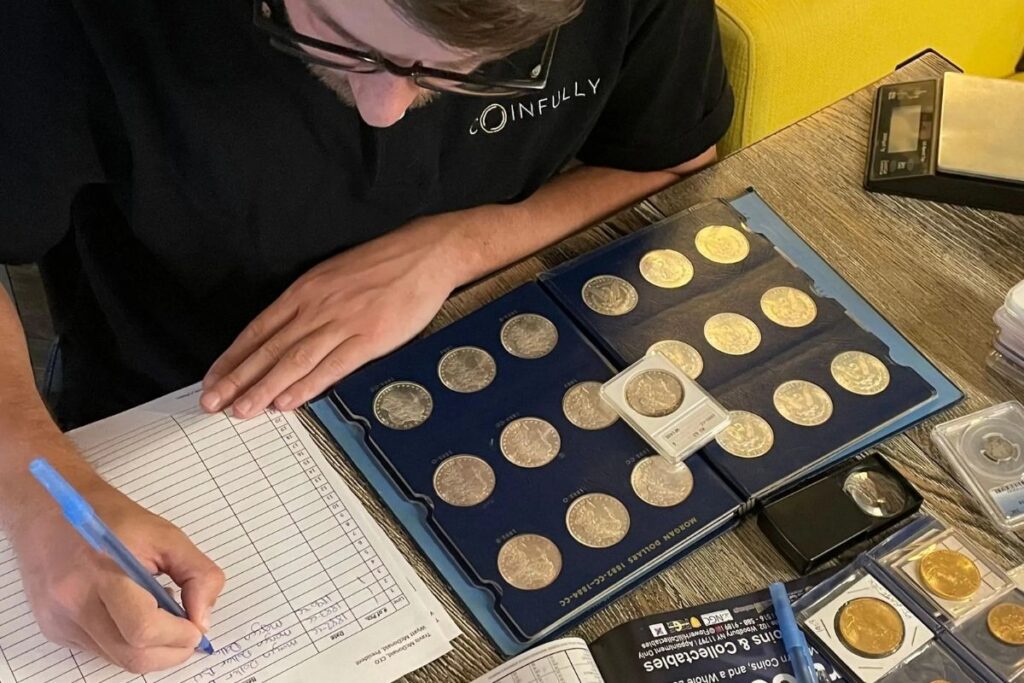
No amount of personal research replaces a professional coin appraisal.
A qualified numismatist will authenticate your coins, assign grades based on established standards, and provide current market values, not just catalog values, which can differ significantly from what buyers are actually paying.
When selecting an appraiser, look for membership in organizations such as the American Numismatic Association (ANA) or the Professional Numismatists Guild (PNG). These memberships indicate a commitment to ethical standards and ongoing education.
Consider Professional Coin Grading for Very Rare Coins
If your collection contains potentially high-value coins, such as key dates, early American coinage, gold coins, or old coins in exceptional condition, professional third-party grading is worth the cost.
Services such as the Numismatic Guaranty Company (NGC) and the Professional Coin Grading Service (PCGS) will authenticate, grade, and encapsulate coins in tamper-evident holders called “slabs.”
A coin graded and certified by one of these services is significantly easier to sell at full market value because buyers trust the independent assessment.
Grading fees vary based on the coin’s declared value and the turnaround time you select, typically ranging from $20 to several hundred dollars per coin.
For common coins, the fees far outweigh the benefits; for rare coins, certification can add hundreds or thousands to the realized price.
Store Securely
Proper storage protects both the physical condition of your coins and their monetary value. Individual coins should be kept in non-PVC holders, flips, or capsules.
Avoid PVC holders. PVC (polyvinyl chloride) leaches chemicals that cause a green, hazy residue called “PVC damage” that can permanently harm a coin’s surface.
Cardboard 2×2 staple holders, Mylar flips, and hard acrylic capsules are all safe options. Coin albums and folders are acceptable for less valuable pieces but can cause contact marks over time.
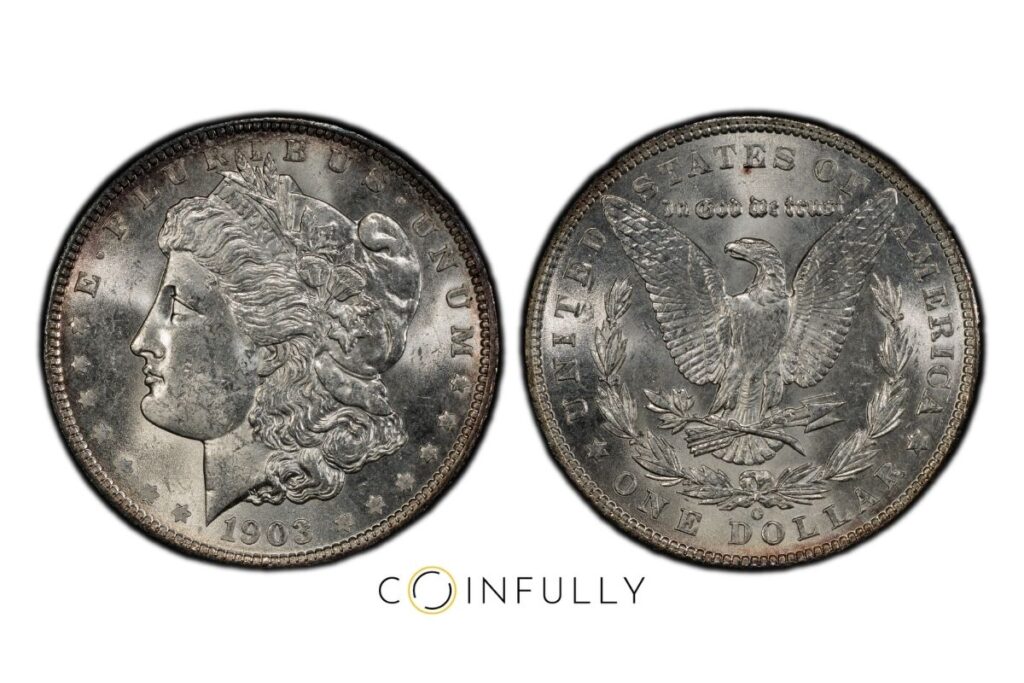
Store your collection in a cool, dry environment with stable humidity. A small dehumidifier in your storage area and the use of silica gel packets can prevent moisture damage, particularly for silver coins, such as valuable Morgan dollars, that are susceptible to toning and corrosion.
Consider Insuring Your Coin Collection
A large or valuable coin collection is a tangible asset, and like any significant asset, it should be protected against theft, fire, flood, and accidental damage.
Standard homeowner’s or renter’s insurance policies typically cover coins only up to a low sublimit, often $200 to $1,000, which is almost certainly insufficient for a serious collection.
A separate scheduled personal property endorsement or a specialty numismatic insurance policy will provide coverage based on the appraised or replacement value of your collection.
Having a current, professional appraisal on file is a prerequisite for most specialty policies and will also streamline any future claims.
Decide Whether To Keep or Sell
This is ultimately the most personal decision in the process. Keeping a collection can be a smart choice, as coins are tangible history, and a well-maintained collection can continue to appreciate in value over time.
Selling makes sense when the proceeds would be more useful than the collection itself, when you lack the interest to continue building or maintaining it, or when estate distribution requires converting assets to cash.
Many collectors choose a middle path, retaining a curated selection of the most personally meaningful or valuable pieces while selling the remainder. Whatever you decide, making that choice after completing a professional appraisal ensures it is an informed one.
What NOT To Do With Coin Collections
Certain missteps can cost you substantially and should be avoided at all costs.
- Do not clean coins under any circumstances before an appraisal.
- Do not sort or separate coins that came stored together in a particular way without documenting their original arrangement, as provenance can add value.
- Do not accept the first offer you receive without comparison shopping; a single dealer’s offer reflects their profit margin, not necessarily the market.
- Do not take a large collection of coins to a pawn shop, where numismatic expertise is rarely available and offers routinely fall far below fair market value.
- Do not ignore estate or tax implications if you have inherited a valuable collection; consult a tax professional about stepped-up cost basis rules before selling.
How To Sell a Coin Collection: Quick Guide
There are several legitimate channels for selling rare coins in a coin collection, and each has tradeoffs.
Coin dealers offer convenience and immediate payment, but their offers must cover their overhead and profit, so expect to receive 50–80% of retail value on common material, with better returns on key dates.
Auction houses reach a wide buyer pool and can achieve strong prices for rare coins, though fees and consignment timelines (often 3 to 6 months) are considerations.
Online platforms such as eBay and Reddit give you direct access to collectors, but they require photography, packaging, shipping, and buyer management. Estate sales and coin shows are additional options.
For large collections, getting multiple offers from at least two or three sources before committing is the most reliable way to ensure you receive fair market value.
What To Do With a Large Coin Collection: How Coinfully Can Help
When you are facing the challenge of appraising and potentially selling a large coin collection, we make the process as straightforward and rewarding as possible.
We built Coinfully to give coin sellers a transparent, top-of-market experience without the usual hassle. Our free online coin appraisal lets you photograph your collection at home, submit the images, and receive a professional valuation from one of our numismatic experts.
If you accept our offer, you ship your coins to us via USPS. Your package is fully covered by Lloyd’s of London, and payment is issued on the day of receipt and verification.
For qualifying large or historically important collections, our concierge at-home appraisal service sends a numismatic expert directly to your home. We evaluate your collection on-site in a fully transparent process with no preparation required on your end.
Most collections are completed in a single day, and if you accept our offer, payment is issued within minutes.
Ready to get started? Contact us today to learn how much your coins are truly worth and receive a top-of-market offer for your collection. Give us a call at 704-621-4893 to learn more or if you have specific questions.
Frequently Asked Questions
How do I know if my coin collection is valuable?
Start by identifying key dates, mintmarks, and coins in high-grade condition using a reference such as The Official Red Book. Certain foreign coins, gold coins, and early American issues tend to hold strong value. The most reliable answer comes from a professional numismatic appraisal, which provides both authentication and current market pricing.
What are the best coin collecting books?
The Official Red Book: A Guide Book of United States Coins by R.S. Yeoman is the essential starting point for any U.S. collector. The Official Blue Book: Handbook of United States Coins gives wholesale values. David Bowers’ Expert’s Guide to Collecting and Investing in Rare Coins is invaluable for those building or inheriting serious collections.
How long does it take to sell a coin collection?
It depends on your method. Online appraisal services can complete the process within days of receiving your coins. Auction consignments typically take three to six months. Selling to a local dealer can be done the same day, though the offer may reflect less than full market value without comparison shopping.
Is coin collecting still popular today?
Yes, coin collecting remains one of the most widely practiced hobbies in the United States, with millions of active participants. Interest surged notably during the COVID-19 pandemic and has maintained strong levels. Rare coin prices have also risen steadily over the past decade, supported by growing demand from both domestic and international collectors.
What are the most collectible coins?
Among U.S. collectible coins, the most sought-after include the 1909-S VDB Lincoln cent, 1916-D Mercury dime, 1932-D and 1932-S Washington quarters, key-date Morgan and Peace silver dollars, and early gold coinage. Proof coins, first-strike issues, and coins with low surviving populations in high grades are consistently in demand among serious collectors.
The post What To Do With a Large Coin Collection: Expert Guidance appeared first on Coinfully - the Best Way to Sell Coins | Free Appraisals.
Original post here: What To Do With a Large Coin Collection: Expert Guidance


Comments
Post a Comment